
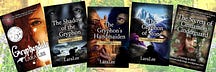


Lara: This is a guest blog post from the very talented producer of my audiobook, Gryphendale, coming out at the beginning of November. I highly recommend her as a great producer, and you will love all the colorful accents she used to bring Gryphendale to life!
Hello! I'm Trista Shaye – voiceover artist and YA and MG author. Super thankful for the opportunity to share with you a little about myself and hopefully answer the question: what makes an author a great person to work with on the audio version of their book. I'm here to say, this process isn't hard and if you keep a few simple things in mind as you go into the audiobook production world, things should go fairly smoothly for you.
I’ve always loved books. I used to have my library card number memorized and would order heaps of Barbie and fantasy books each week to read through. When we had sleepovers, my best friend and I would discuss the current book we were reading together and how we each pronounced the character’s names. I had lists of book titles I'd made up written on random pieces of paper and also wrote some songs for a few of them – none of these old writings have ever made it further than that.

My childhood set me up to enjoy the written word and I always dreamed of becoming an author. At sixteen I published my first full-length novel and the year after I published my second. And quite honestly, I believe that being an author myself helps me to better understand where some of the authors I work with are coming from.
Growing up, my parents would read to us quite often. Both of them always read each character with their own specific voice - and my mother often had a phrase she would say for specific accents, if there got to be too many characters at once.
As I grew older, and as I read more on my own, I would pick a character at the beginning of a book or series as “my” character and - either in my head, or aloud - I would read their lines like that was me actually in the story. I also believe this, as well as my history in theater and indie film, helped prepare me for the work of voiceover.
People ask me all the time, “How do you even get started in narration or voiceover?”. I usually direct them to Audible’s ACX, where it’s free to set up a narrator profile and you can audition for any titles you want, and you can usually land a project quite easily. However, I didn’t begin there.

My first book, though in the end it was published through ACX, started out on Facebook in a writers group. I believe it was God’s handiwork that I saw the post asking for auditions for the book, that I already had a nice microphone and knew how to use it, and that I was somehow the exact voice they were looking for to bring the book to life. I never once thought about being a narrator up until that point, but I had always wanted to try voice acting, and the opportunity was dropped into my lap.
My first audiobook was … a learning curve, we’ll say. I learned so much from it. But once I had finished it, I was hooked on this thing called voiceover and found I really enjoyed heading into “my office” each day for work. I loved bringing each character to life with their own unique voice, I enjoyed the challenge of changing from one accent to another and learning how to put sound effects to kid’s books. But my favorite thing as a voiceover artist and specifically a narrator - which can also be the most frustrating part, as well - is all the people you get to meet, all the authors you form relationships with as you work on a story that's written from their heart.
I’ve had the opportunity to produce over fifty audiobooks on ACX, and I’ve worked with about twenty-plus different authors. My experience has been mixed, as I’ve had to learn how to ask the right questions about aspects of each book, and even then, I’ve had authors lie to me. But the majority of the projects I’ve produced and the people I’ve worked with have been good, and even the bad experiences have taught me valuable lessons.
So, you’re wondering, what makes an author the best person to work for and with, or the worst? The one-word answer: communication.
That’s a pretty broad topic though, so I’ll narrow it down into several bullet points.
Always send a reply. If a narrator contacts you prior to the audition with questions – even if they seem obvious to you – answer them with a message, even if it's days later and you forgot; do it! I hardly ever audition for a title if I don't get a message in response to my query, and I always send a message prior to my auditions. Answer all their questions before and during – it's helpful to know you're as invested in this project as we are.
Explain the best you can about what you're looking for. You can only explain so much about the type of voice you want and then it all comes down to hearing each audition. Post YouTube video links, or audiobook links, if you have certain voices in mind for a narrator or for characters – being able to hear what you want as the author is much easier for a narrator to grasp than just saying, “you know, James Earl Johns, but also a bit of Delia Owens”. Can I hear what you mean when you say that?
Post a range of characters for the audition and keep them short. Try to post a large range of characters – if your book has a large range of characters – for the audition. Also, keep the audition as short as you can – usually up to five minutes is the max. We understand you want to hear our voices but you'll usually be able to tell if the narrator is right for you or not within the first twenty to thirty seconds and long auditions – anything above ten minutes – is pretty much unnecessary. If you like a narrator, however, you can ask them to audition again with another section of the manuscript that they either didn't get to or you haven't posted but you want to see if it works with their voice. Don't ask for more than one of these extra auditions, though, unless they offer.
Understand everyone's voice is different. Everyone's voice is different, and someone who might be good at voicing the little girl in your story might not have the same range to voice the deep male who comes in later on. And someone else might be able to both pretty alright. If a narrator's voice is generally on the higher end, don't expect for them to strain their vocals to try and get that deep rumbling voice you might have pictured. Choose what's more important to you – which characters you absolutely want a certain way, and which can come under the narrator's vocal range.
Give us space to do our thing. I love this when an author gives me free rein to decided how to voice the characters – it's so freeing and a lot more enjoyable. That being said, if you had a certain voice in mind for certain characters, please state that to begin with, but if for other's you don't really care as much, just let us know and cut us loose. A good narrator is an actor/actress as well and they know how to bring out voices you might not have even thought of – and sometimes, they might not have even known they were able to do. If, generally speaking, the narrator doesn't have enough emotion in their voice – which you should have been able to tell by the audition – you can mention this. But try to refrain from “This needs to sound more sad”, “This isn't happy enough”. Again, a good narrator is an actor/actress and they should get those cues from the writing.
Corrections. Hey all, we all make mistakes. If you notice a correction that needs to be made in the narration or a character's line, tell us! Don't feel shy or like you might make us feel bad, just tell us. We appreciate it, really. We'll be more than happy to fix it, it's probably something that takes a few seconds to do and it makes your book sound better in the end. As to full chapter revisions, that's something you need to be careful with. You chose this narrator based on their audition and you can't expect for them to do anything different than like in the audition. I had an author ask for me to revise several character's voices in a chapter three different times – all the lines. Once you get into that water, you need to understand you're likely going to have to start paying more to make up for the time you're asking them to put into it. Also, please don't expect for the character's voice to always sound 100% the same through the whole book, either. Day to day your voice will sound a little different because of what you drink, how you slept, how early in the morning it is, so on. Obviously glaringly different changes in a character's voice would need to be addressed, but something minor is best left alone. Even when I'm talking normally to someone, my voice can rise and fall in pitch depending on what's being said. It's honestly realistic.
Let those who auditioned but didn't make it know. It's always so nice to me, and rare, when I've auditioned for a title but not gotten it, that then the author will send me a little message and say they've chosen someone else but they appreciated my time. Do this, it sets you above the norm.
Don't lie and be nice. These go without saying but it has to be said because I've dealt with both. Please don't lie about the content of your book if a narrator asks, we will find out your lying if we're narrating it, after all, and then you have to deal with it. Not the best way to go. Also, be as nice as possible. Narrators/voiceover artists deal with rejection constantly and are in contact with many people, just be graceful with all communication.
Pay your narrator. You wouldn't ask a plumber or a cover artist to do what they do professionally for free – I mean, you may but you would get some looks. Same goes for any narrator. This is their job, for me it's my full-time job right now, and royalty share split basically means you're asking the talent to produce your book for free – for me, I record, edit and master your files; that's a lot of free and bills don't get paid for free. Going into getting your audiobook produced, prepare for the fact that you're asking someone to spend countless hours bringing your words to life and prepare by saving up for it. It's worth it to pay them.
I do several royalty share books per year, but normally I just can't afford to. Most authors who want audio can't afford to pay me and they know they can find someone else who will do it for free. This is hurting the voiceover, and specifically, the audiobook narrator industry, as it forces those of us who need to get paid – and honestly, should get paid – into having to look further and wider for any sort of work.
Royalty share plus is amazing, it's the best of both worlds. It means a lower hourly rate is needed for you to pay the narrator, and you also split the royalties, allowing you not to break the bank, and allowing the producer to actually get paid.
Don't expect your narrator to be your promotional agent. I do usually post my latest projects when they're completed to my social medias, but that's about it. We get paid to read your book, not to promote it. Some authors think if they choose royalty share they can get their narrator to promote the book all the more because it benefits them. Truth is, I post once for all books, paid or royalty. This may sound harsh, and you can always ask if we're willing to post or share promotional links, and usually, we'll say yes, but don't just expect us to.
Review your narrator and encourage them. Tell other people about your narrator. At the end of a project, it's always nice to know how you did, no matter who you are and what you're doing. Like I said, we deal with a lot of rejection and knowing you appreciated our work means a lot. A review – that you can just send via message to the narrator – can be posted to our profiles and websites and can help us get future work, as well. Tell your author friends who might be interested in audio about your narrator – networking is such a great way to get us more work and we'll always appreciate a mention even if nothing comes of it.
I hope these bullet points made sense, and more importantly, I hoped they helped you think about a few things you might not have considered before if you're considering getting your book produced into an audiobook. I could say a heap more about all of this, but I tried not to be long-winded and just sum up some of the most important things.
I'm always open to answer any questions you might have about the process of audiobooks and you're more than welcome to email me: tristashayeofficial(at)gmail.com
Visit me on ACX, my Website (the link for my website can also be found on my ACX profile), Instagram, or Facebook.
All the best in your writing and audio endeavors!
Trista Shaye
Link to ACX profile: https://www.acx.com/narrator?p=A2B9XGW94CY924
Link to Website: http://tristashayeofficia.wixsite.com/voiceover

Check out my young adult fantasy fiction novels HERE for something optimistic and fun.